
A missed sailing costs more than a roll-over fee. It costs credibility. For a booking coordinator, the three deadlines on every ocean freight job—SI, VGM, and CY—are the difference between a smooth departure and a customer complaint. Mastering the cut off time shipping for each sailing isn't about memorising numbers; it's about knowing where to find them and building a process that never misses them.
A shipping cut-off is the latest time a carrier or terminal will accept something needed for a particular sailing—such as shipping instructions, the verified gross mass or the container itself. Miss it and the cargo can be shut out and rolled to a later vessel. Cut-offs are set per carrier, vessel and terminal and are normally shown on the booking confirmation. There is no single standard cut-off number, so use the shipment-specific deadline rather than a generic rule.
This article is a desk-level guide for freight forwarding operators. We'll break down the three main cut-offs, what happens when you miss them, and a practical checklist to keep your cargo on the vessel it was booked on. This is a core part of bridging the gap between yes and a job order and is covered in more detail in the complete guide to carrier booking.
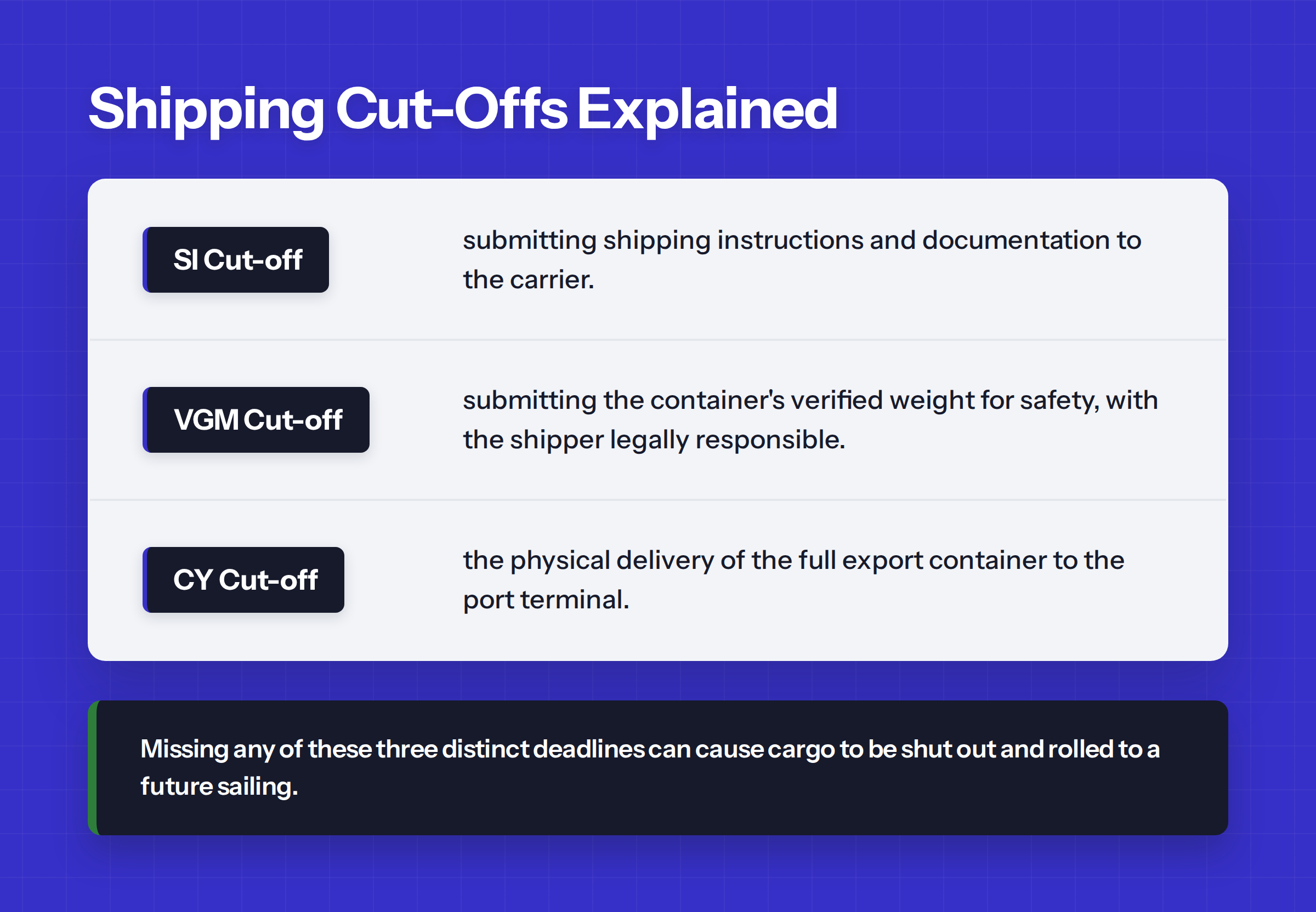
The three cut-offs on every ocean booking
Every ocean booking has at least three critical deadlines. They are related but separate; meeting one does not excuse missing another. The carrier’s booking confirmation is the only reliable source for these times. They are never standard and can change based on the port, terminal, and vessel schedule.
| Cut-off | What it is | Who sets it | What must reach whom |
|---|---|---|---|
| SI / Documentation Cut-off | The latest time for submitting complete shipping instructions (SI) to the carrier. | The ocean carrier. | The forwarder must send complete SI data to the carrier's documentation team or portal. |
| VGM Cut-off | The latest time for submitting the Verified Gross Mass (VGM) of the packed container. | The carrier, based on terminal and stowage planning needs. | The shipper (or forwarder on their behalf) must send the VGM to the carrier and/or terminal. |
| CY / Port Cut-off | The latest time a full container can be physically delivered (gated in) at the designated Container Yard (CY) or terminal. | The port terminal, in coordination with the carrier. | The trucker must deliver the container to the correct terminal before receiving closes for that vessel. |
SI or Documentation Cut-off (doc cut off)
The si cut off meaning is simple: it's the deadline for the paperwork. The carrier uses your Shipping Instructions (SI) to create the Bill of Lading (B/L) and file any required advance manifests with customs authorities. A complete SI includes the full names and addresses of the shipper, consignee, and notify party; a precise cargo description; container and seal numbers; piece count, weight, and measurement; and freight payment terms. The doc cut off is not a suggestion; it’s the point at which the carrier finalizes the ship’s manifest.
VGM Cut-off
The vgm cut off meaning relates to a critical safety rule. Under the International Maritime Organization's (IMO) Safety of Life at Sea (SOLAS) convention, no packed container can be loaded onto a vessel without a Verified Gross Mass (VGM). The vgm cut off is the carrier's deadline for receiving this weight. According to the IMO's guidelines, the shipper named on the B/L is responsible for providing the VGM. There are two permitted methods:
- Method 1: Weighing the entire packed and sealed container using calibrated and certified equipment.
- Method 2: Weighing all cargo items, dunnage, and packing materials, then adding that sum to the container's tare weight as printed on the container door.
CY or Port Cut-off
The cy cut off meaning refers to the physical delivery of the container. The cy cut off, or container yard cut-off, is the latest time the truck can arrive at the terminal gate and have the container accepted for a specific sailing. This is often confused with the vessel's departure time, but the terminal closes for receiving cargo much earlier to allow time for sorting containers and planning the stowage. For ports like Nhava Sheva, Jebel Ali, or Felixstowe, the port cut off can vary significantly between terminals, even for the same vessel.
What happens when you miss each one
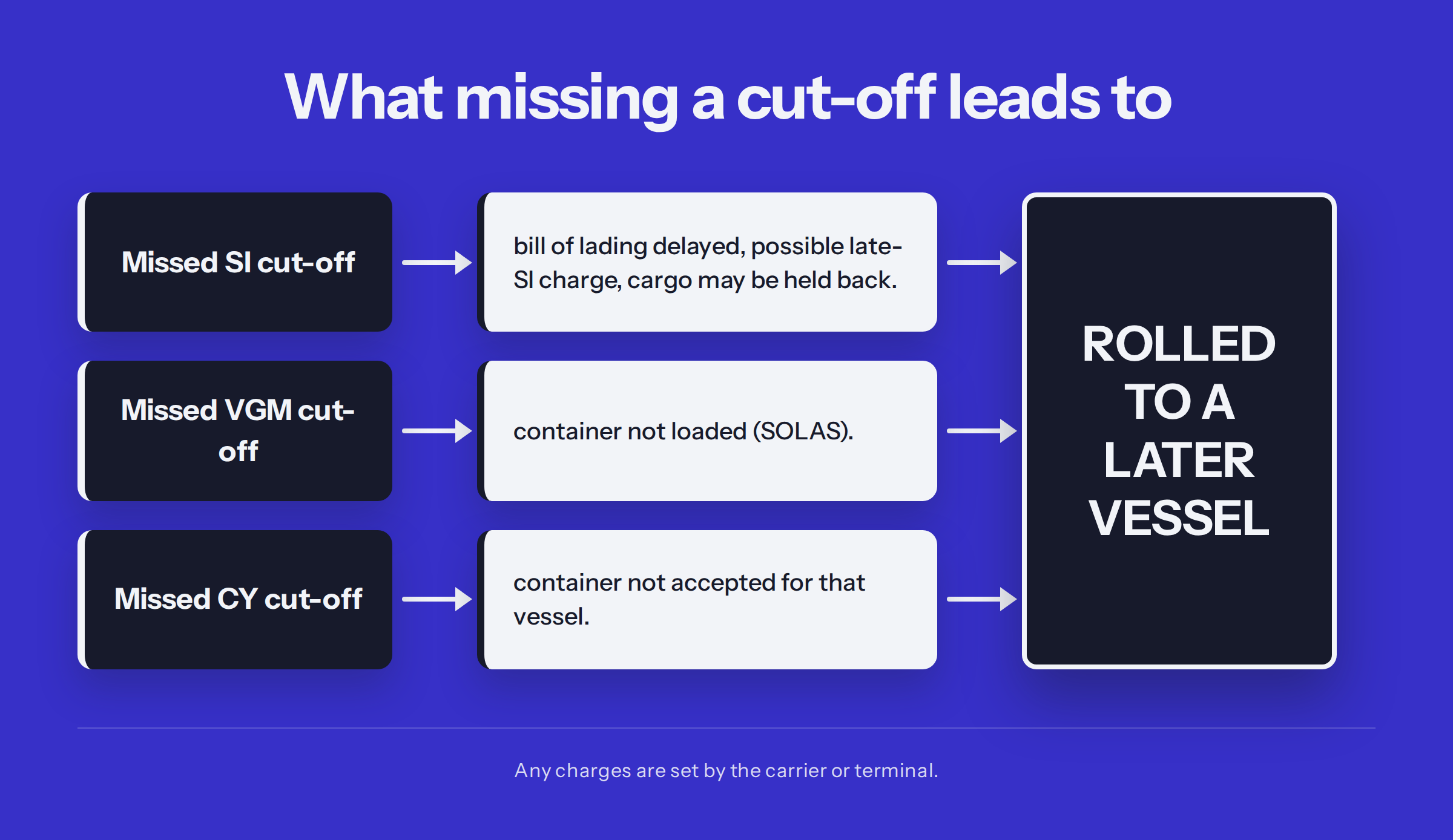
Missing any cut off time shipping has direct consequences. While carriers and terminals set their own policies and fees for late submissions, the operational outcomes are consistent across the industry.
Missed SI Cut-off
If you submit shipping instructions after the doc cut off, the carrier may not have time to process them. This can lead to several problems. The Bill of Lading might be delayed or contain errors, holding up payment or customs clearance at the destination. Carriers often charge a "Late SI Fee" or an "SI Amendment Fee." In a worst-case scenario, if the manifest data cannot be filed on time for regulatory purposes, the carrier may hold back the container and roll it to the next sailing.
Missed VGM Cut-off
The consequence of a missed vgm cut off is unambiguous. The IMO is clear: a packed container without a VGM must not be loaded onto the ship. As Maersk and other carriers state in their guidance, if the VGM is not provided in time for the stowage plan, the container will be left at the terminal. There is no negotiation. The container is shut out, resulting in storage costs, re-booking fees, and a delayed shipment. It is a hard stop in freight forwarding operations.
Missed CY Cut-off
When a truck arrives at the terminal after the cy cut off, the gate is effectively closed for that vessel. The terminal's system will not accept the container for the booked sailing. The container becomes shut out cargo. It must be rolled to a subsequent vessel, which requires re-booking with the carrier and updating all documentation. This not only incurs costs for storage (demurrage) and potential re-handling but also breaks the delivery promise to your customer. For a deeper look at the process, see our article on what happens when cargo gets rolled.
A checklist for never missing a cut-off
Preventing rolled cargo is about process discipline. A single operator can manage dozens of bookings without issue by treating each deadline as a critical milestone. This checklist helps build the right habits.
1. Read every cut-off from the booking confirmation
Never assume this week's deadlines are the same as last week's. Vessel schedules, terminal congestion, and carrier policies change. The booking confirmation issued for that specific sailing is your source of truth. As carriers like Hapag-Lloyd note, the confirmation includes all relevant cut-off dates.
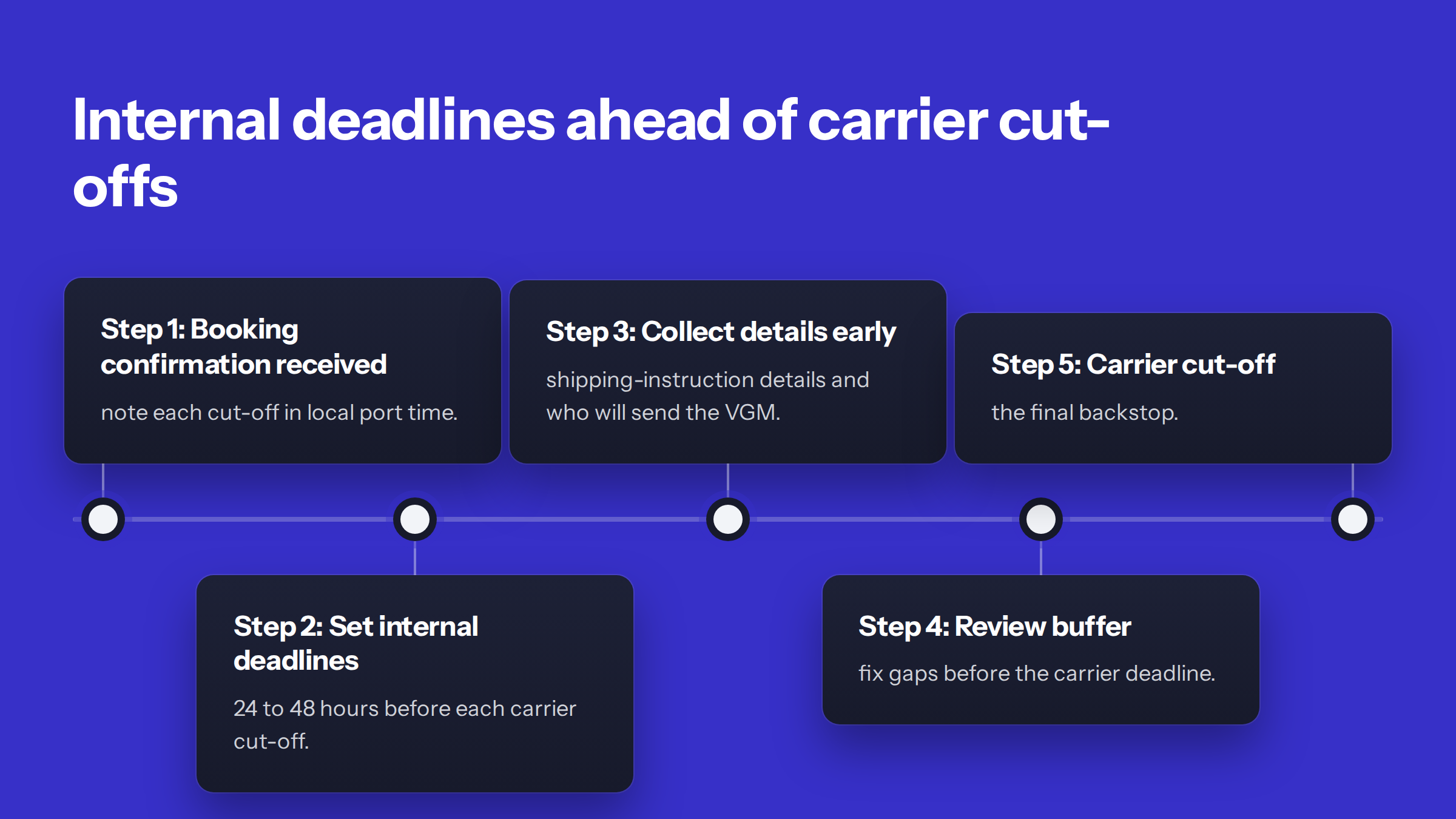
2. Write them on the job in local port time
A cut off time shipping is always in the local time of the port of loading. Note this explicitly in your job file (e.g., "14:00 Mundra Local Time") to avoid confusion, especially when your team, the shipper, and the port are in different time zones.
3. Set internal deadlines ahead of each carrier cut-off
The carrier's deadline is your final backstop, not your target. Set internal deadlines for your team and the shipper that are at least 24-48 hours earlier. Make these internal deadlines visible to everyone working on the job file in your TMS.
4. Confirm the VGM process with the shipper early
When the booking is made, ask the shipper how the VGM will be determined (Method 1 or 2) and who will be responsible for sending it. The shipper is legally responsible under SOLAS, but they often rely on the forwarder to transmit the data. Document this agreement.
5. Collect shipping-instruction details when the job opens
Don't wait until the day before the SI cut-off to chase consignee details or an accurate cargo description. A core principle of efficient operations is asking once for everything missing at the start of the process, not at the end.
6. When the vessel schedule changes, re-check every cut-off
If a carrier notifies you of a vessel delay, do not assume the cut-offs have been extended. Terminals may keep the original receiving window to manage yard space. Always wait for a revised booking confirmation with new, official cut-off times.
7. Tell the customer early when a cut-off is at risk
Proactive communication builds trust. If the shipper's cargo isn't ready or a truck is delayed, inform your customer of the risk to the cut-off and the potential for a roll-over. It's better to manage expectations than to report a failure.
Where Booking Desk AI fits
Managing multiple deadlines across dozens of jobs is where human error creeps in. This is a coordination challenge, not a knowledge gap. Booking Desk AI works alongside your coordinators by taking the re-keying and the first request for missing details off their desk, so their attention stays on the deadlines.
From Won Quote to Complete Job
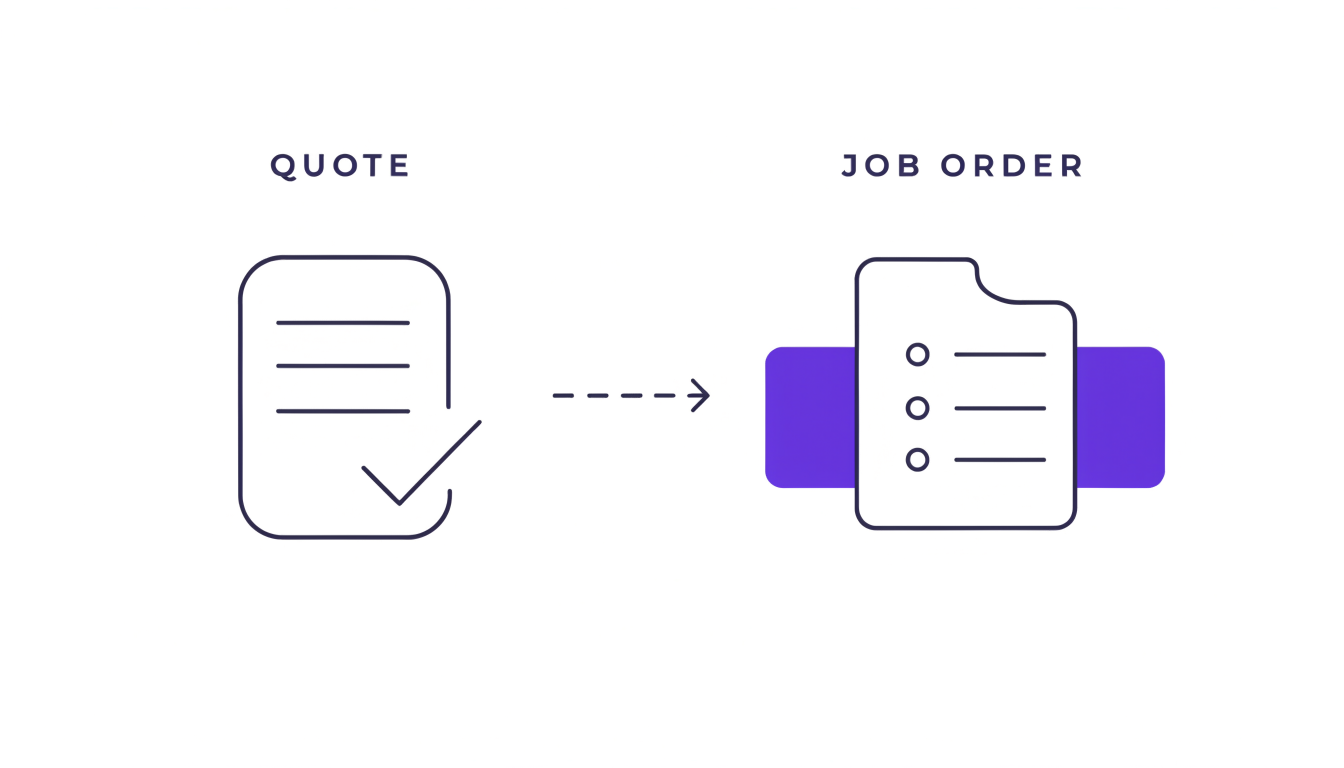
The process starts the moment a customer says yes. Instead of manual re-keying, a won quote becomes a job on its own, fully filled in. All the data from the quote—shipper, consignee, cargo details, and routing—is automatically structured into a new job file. This preserves the details of what a job order holds without data entry.
Spotting and Requesting Missing Details
Booking Desk AI then validates the job against the requirements for an ocean booking. It spots what is missing and drafts the email asking for it. For example, if the consignee's full address is missing for the SI, it prepares a message for your coordinator to review and send. Every message a customer sees waits for a person, who can edit, approve or reject it.
Approved Bookings on Your Carrier Accounts
Once the job data is complete, the system drafts the carrier booking. After your coordinator approves it, the booking runs through connectors FreighAI builds for the customer, on the customer's own carrier accounts. This keeps your carrier relationships and rates intact while eliminating the tedious copy-paste work of using carrier portals. It's a clear advantage over manual job entry compared.
The goal is to let your team focus on managing exceptions and serving customers, not on administrative tasks. The customer said yes, and the desk does the rest. To see it in action, see a yes become a job.
Frequently Asked Questions
Is the CY cut-off the same as the port cut-off?
Yes, the terms "CY cut-off" (Container Yard cut-off) and "port cut-off" are generally used interchangeably to refer to the same deadline: the latest time a full export container can be delivered to the terminal for a specific vessel. However, always check the carrier's booking confirmation for the precise terminology and designated terminal name, as different terminals within the same port can have different cut-offs.
Who submits the VGM?
Under the IMO's SOLAS convention, the shipper named on the Bill of Lading is legally responsible for providing the Verified Gross Mass (VGM). In practice, the shipper may perform the weighing themselves or authorize a third party (like a warehouse or trucker) to do so. The forwarder often plays the role of transmitting the VGM data to the ocean carrier on the shipper's behalf, but the legal responsibility for the accuracy of the weight remains with the shipper.
Can a cut-off be extended?
Yes, but it is rare and never guaranteed. Only the ocean carrier or the terminal can grant an extension, known as a "late gate" or "late SI acceptance." This is typically handled on a case-by-case basis and may depend on the reason for the delay, the vessel's schedule, and the forwarder's relationship with the carrier. You must request an extension before the deadline expires and get written confirmation; never assume it will be granted.
What does 'shut out' mean?
In shipping, 'shut out' means the cargo was not loaded onto the vessel it was booked to sail on. This usually happens because the container missed the CY cut-off, the VGM was not submitted on time, or there was a documentation or customs issue. The shut-out container is left at the port and must be re-booked on a future sailing, a process known as "rolling."
How can I avoid missing a cut off time shipping?
The most effective way to avoid missing a cut off time shipping is through disciplined process management. Always use the booking confirmation as your single source of truth for deadlines. Record the SI, VGM, and CY cut-offs separately for each job in the port's local time. Set internal deadlines that are at least 24-48 hours before the carrier's deadlines and communicate these clearly to the shipper and your internal team. Finally, use a system to track these milestones and alert you when a deadline is at risk.
What is the difference between SI, VGM, and CY cut-offs?
They are three distinct deadlines for three different requirements. The SI cut-off is for submitting documentation (shipping instructions) to the carrier. The VGM cut-off is for submitting the container's verified weight for safety and stowage planning. The CY cut-off is for the physical delivery of the container to the port terminal. Missing any one of these can cause your cargo to be shut out, even if you meet the other two.
Sources & References
This article draws on research and data from the following verified sources:
From reading to watching.
Everything on this page runs live in a working booking desk. Bring one accepted quote and watch it become a booked job order.
Book the working sessionKEEP READING